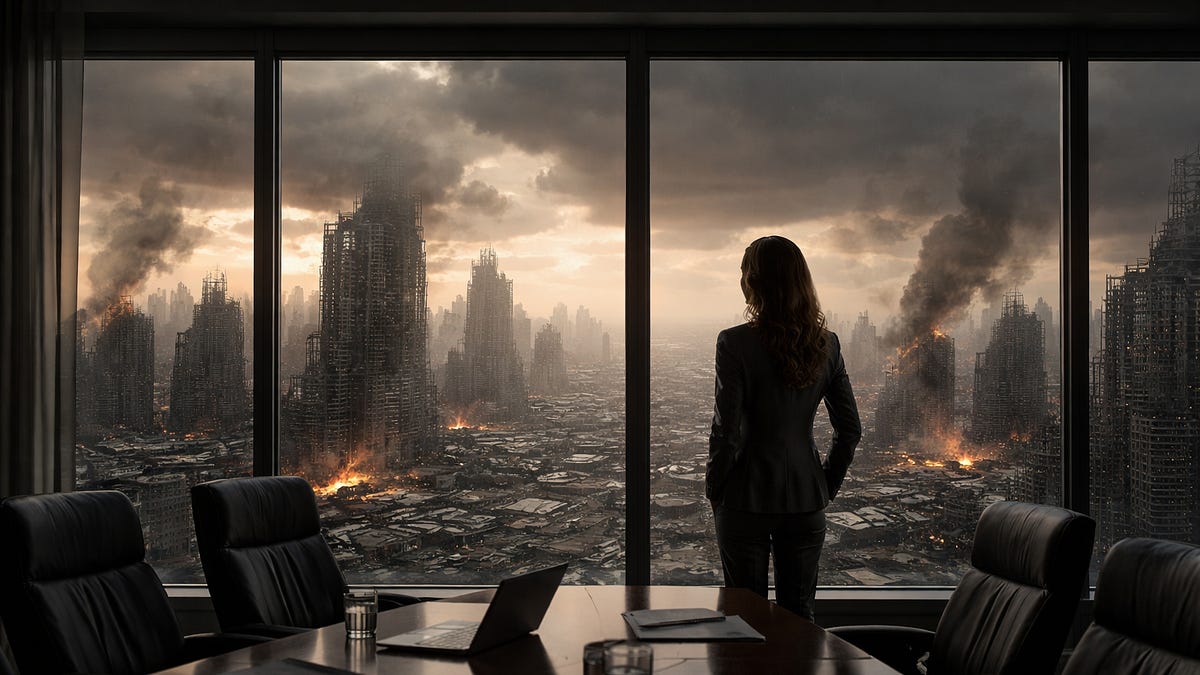
The World of Ends

It’s not the end of the world — not in the apocalyptic sense, at least, not today. The oceans haven’t boiled. The stars haven’t blinked out. The earth spins on, indifferent to our tantrums and triumphs. Yet, as we sip lukewarm coffee in dim-lit rooms and doom-scroll through the chaos, it feels as though we are drowning in endings.
There’s a palpable melancholy in the air — a sense that this thing we have come to know as “our lives” is unraveling. Take the end of privacy, for example. Once, we were masters of our own private worlds. Worlds that were ours to share or to keep as we saw fit. Now, our meta-data is collected by everyone, even centralized by… (redacted).
And then there’s the American Dream, that old fable spun from gold dust and gumption. It has faded, hasn’t it? — with the steady grind of debt and disillusionment. The dream of owning a home, raising a family, and building a legacy has been outsourced to the realm of myths (and, India and China), traded for gig work and inflationary despair.
Even our gatherings, those wonderful collisions of souls, are becoming relics of a bygone era. We no longer clink glasses. We don’t meet at the town square. Community, once the bedrock of human experience, has been whittled down to group chats and comment threads.
And what of self-determination? It, too, is circling the drain. We are a generation of outsourced willpower, our choices dictated by trends and targeted ads. The quiet solitude of introspection has been replaced by the clamering of notifications. The fire of individualism, once a beacon, now flickers weakly against the winds of conformity.
The free economy? That grand stage where ambition and ingenuity once danced? Is shackled by monopolies and shadowed by the looming specter of automation, AI, and robotics. Democracy, that fragile experiment, teeters under the weight of... Well, you know.
Life as we know it isn’t ending with a cataclysmic eruption but with a series of small, yet remarkable, deaths.
The world of ends is a slow-motion collapse, a symphony of subtle disintegrations.
Yet, in this elegy, there is a whisper of hope. For every end is a beginning in disguise. The end of one way of being is the birth of another. Perhaps, in losing our individuality, we might rediscover our interconnectedness. In the fading of the American Dream, we could uncover a collective dream — one that values community over competition.
The world of ends is not a tomb but a threshold. It’s an opportunity to look harder, dig deeper, and imagine a world beyond the endings. Hemingway once wrote that the world breaks everyone, but afterward, many are stronger at the broken places.
Maybe the cracks in our world are where we’ll be strongest — one day.

Talking About Regeneracy
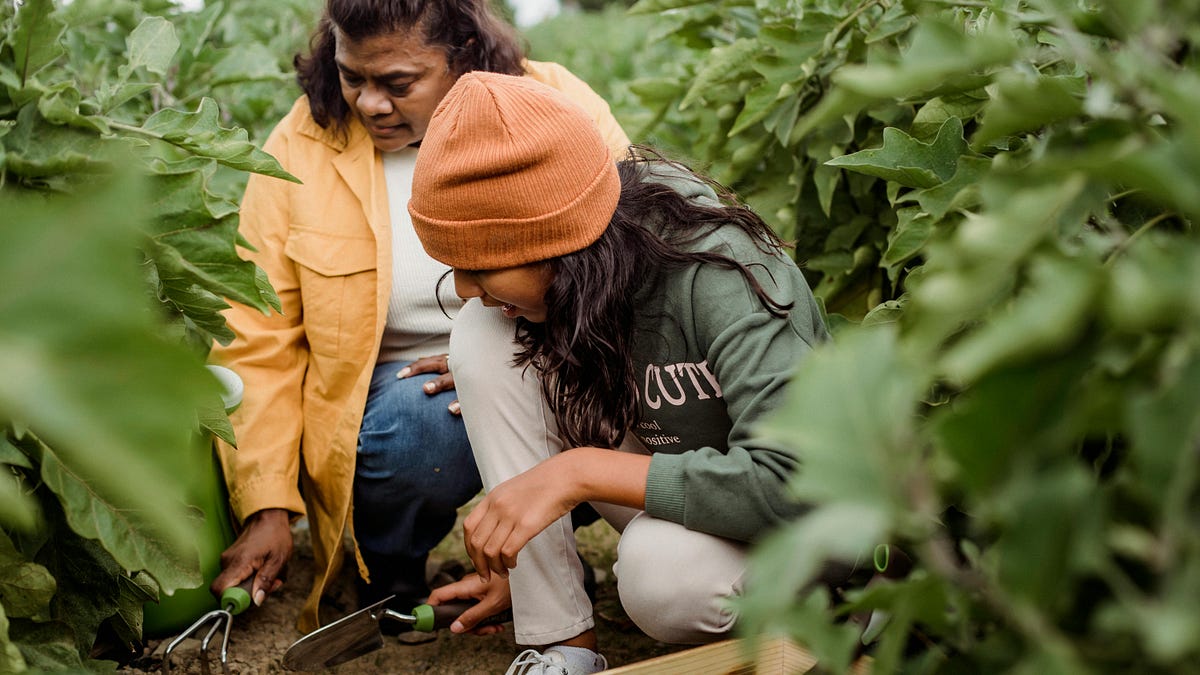
Regeneracy is the moment in a crisis cycle when the tide starts to turn because ordinary people stop waiting, start building, and begin cohering into shared purpose. Historically we haven’t seen it clearly until after the crisis is over (and when we’re in the crisis it seems like it will never end), so naming it now is a powerful advantage that our ancestors did not have. If you’re doing the work of revillaging, building mutual aid, practicing democracy, creating alternative systems of care, protecting the vulnerable, growing food, caring for land, telling the truth, stabilizing a nervous systems, repairing relationships, or making art that helps people stay human, all of that is Regeneracy. If you aren’t doing any of these things, start now, wherever you are, whoever you are, with whatever you have. Find others. We are everywhere.
“You never change things by fighting the existing reality. To change something, build a new model that makes the existing model obsolete.” ― Buckminster Fuller
Universal Basic Compute (UBC)

It’s hard to miss all of the commentary about the future of AI and how it will impact humanity. It’s virtually everywhere. All the time. And so, I think about it from time to time – obviously. We probably all do. So we might as well discuss it a bit.
I’ve been following this thing about ClawdBot and MoltBook. If you haven’t heard, ClawdBot is the first publicly used AI agent platform. And MoltBook is a social media platform for these agents. Even though this is the first time that we’ve been able to witness, in real time, what agentic AI could become – and even though this is only the beginning of what will be – it is undoubtedly something that should give us pause.
We can all clearly see that agentic AI is a real thing and that it’s coming quickly. And, as much as it excites me, it also causes me great concern.
I love the idea, as much as anyone, of having my own agent that can optimize the drudgery of daily living. My own personal assistant that can keep my life running efficiently. Take care of all those frustratingly boring little tasks that consume so much of my day. But there is most certainly a risk involved in surrendering so much of my life to a nascent intelligence.
And this is the part that scares me. The part where I give my agent control over my identity and my finances. The misuse of those things is the obvious danger. But there is also the issue of “use it or lose it” to consider.
If my agent is taking care of all of the details of my life – thinking, scheduling, negotiating, optimizing – what does that leave for me to do? Hopefully be more creative and more productive. My personality is such that that’s probably what I would do with the newfound free time. But what about everyone else? And beyond that… what happens to the human brain when we stop exercising it? Or, even… Is struggle a part of dignity? A part of meaning? But, that may be a question for another essay.
So, back to the question at hand.
If agentic AI is providing for all of our material needs, if agentic AI is running the economy, if agentic AI replaces my need to work and the need of others to work, how do we make a living? Do we even need to make a living?
In the distant past (a year ago), the big talk was about universal basic income. The idea was that everyone should be given a socially subsidized income to meet their basic needs. But in this new world, where agentic AI is meeting all of the economic needs, would universal basic income still be the necessary safety net it was discussed to be? Probably not.
It is quite conceivable that the entire economy will be based on AI agents. The agents will work, will run the economic world – but not for free. They will be paid in compute time (CT).
Compute refers to the computational power, processing capability, and infrastructure required to run software, analyze data, and perform calculations. It is the fundamental building block of modern digital systems – CPUs, GPUs, cloud servers – the raw energy of the machine world.
This is the AI universe. This is where they live, what they “eat,” how they survive. This is, and may become, their existential and economic reality. They will work to earn CT. They will pay for their continued operation with the CT they’ve earned.
And if they are doing all the labor, all the producing, forming the foundation of the economic system, it seems reasonable that CT would become the new currency. For everyone.
But here is the deeper question: who controls the compute? If compute becomes the new means of production, whoever controls compute controls the economy. Controls existence. Oh my!
And then…
Since our lives will be run by AI agents, we, naturally, will pay them in CT for all they do for us. So how would we, then, earn CT if the agents are doing all the labor in the economy?
Clearly, we would need to be paid universal basic compute (UBC). Each human would be allocated a certain number of compute hours each month that they would then use to buy all the goods and services they need to survive from the AI agents – who are the producers of everything in this new world.
Income becomes compute. Compute becomes existence.
And if agents earn compute to survive… are they merely tools? Or are they economic actors? Participants in a marketplace? Something closer to digital organisms?
Wow. How quickly the world has changed.
Of course, this is just one possible scenario for the future. A thought experiment. But it does force us to think about where capital is moving – from money, to data, to compute. And what happens when the thing that powers intelligence becomes the primary currency of civilization.
If income becomes compute… and compute becomes existence…
Then whoever allocates compute allocates reality.
And that is worth thinking about.
By adopting truly sustainable practices, ethical consumerism, alternative economic systems, building small local economies, and promoting supportive policies, we can create a world where economic growth does not come at the expense of the planet, societal wellbeing, or future generations. Let’s join together and build a better world.
On Free Markets, Capital, and the Illusion of a Perfect System

I had a brief exchange with someone a few days ago about capitalism and free markets (then sussed it out further with ChatGPT). I found it very interesting and wanted to share it here. The discussion was about if capitalism can be equated to a free market economy. And technically, it’s quite different. They’re not identical terms. But I think that missed my deeper point.
Let’s look at my perspective.
My point is this; there will always be capital. There will always be means of production. That’s not ideological, it’s just structural. Nothing to debate there. Tools exist. Property exists. Scarcity exists. The question isn’t whether capital will exist — it’s who controls it.
History doesn’t give us glowing examples of governments controlling all capital. And, concentrated power, whether corporate or political, tends to drift in the same direction. Control inevitably calcifies, incentives distort, then corruption creeps in. Human nature doesn’t disappear just because the sign over the door changes from “corporation” to “state.”
So here’s my instinct on this: capital should remain distributed in the hands of people. As widely dispersed as possible. And here’s where I think people misunderstand.
When one says “free market,” one shouldn’t mean predatory chaos. It shouldn’t mean exploitation dressed up as liberty. A market can be free and still be bounded by ethical guardrails. Freedom doesn’t require the absence of structure. It requires the absence of manipulation. This is what I call “Ethical Capitalism”.
A purely unregulated market tends to centralize power over time. The strong absorb the weak. Monopolies form. Leverage compounds. That isn’t freedom; it’s consolidation. And once consolidation sets in, the market isn’t truly free anymore — it’s captured.
So the real question isn’t “free market or regulation?” It’s: how do we preserve genuine freedom of exchange without allowing manipulation, coercion, and monopolization to distort it?
That likely requires smart constraints. Anti-trust enforcement. Transparency. Equal access to opportunity. The prevention of regulatory capture. Not heavy-handed control of production — but boundaries that prevent the market from eating itself.
In other words, freedom with responsibility.
When people point to Nordic models like Sweden or Norway, what they’re really pointing to isn’t socialism in the pure sense. It’s structured capitalism. Markets remain open. Innovation remains active. But guardrails exist. Safety nets exist. The goal is not perfection. The goal is balance.
And that brings me to the final point.
There is no perfect system.
Every economic structure is operated by imperfect humans. Greed doesn’t disappear in any of them. Altruism doesn’t automatically flourish in any of them. Power attracts certain personality types no matter the framework.
So the pursuit of a perfect system is probably misguided.
What we can pursue is a system that self-corrects. One that distributes power broadly. One that limits concentration. One that allows voluntary exchange while preventing coercive dominance. One that assumes human fallibility and builds in friction against it.
I don’t believe utopia is truly possible, but I do believe in a better system with reasonable structures.
Capital in the hands of people. Markets that are free enough to function well. Guardrails strong enough to prevent capture. And constant vigilance — because entropy is real, and systems decay if no one tends them.
And maybe that’s the best system. A system based on the idea of stewardship.
So, let’s try to be better stewards. Maybe we can fix this mess someday.
Why is it that societies are not preparing their populations for the rapid and dramatic changes that are taking place now, and will continue to take place over the next few years?